Do Cordless Phones Need a Phone Jack?
A standard cordless phone does need a phone jack, because its base station connects to a landline wall outlet. VoIP bases don't need a live wall jack, though the VoIP base itself still plugs into a phone port, and cell-pairing bases skip the jack by pairing to a cell phone.
On this page (9 sections)
- Do cordless phones need a phone jack?
- Which cordless phones work without a traditional phone jack?
- Can you use a cordless phone on a cable or fiber phone service?
- Why do some cordless phone bases have two jacks?
- Do you need a phone jack in every room?
- What if your house has no phone jacks at all?
- Does a cordless phone base work in a power outage?
- How do you set up a cordless phone without a landline?
- So, do cordless phones need a phone jack?
A standard cordless phone does need a phone jack, because its base station connects to a landline wall outlet. VoIP bases don't need a live wall jack, though the VoIP base itself still plugs into a phone port, and cell-pairing bases skip the jack by pairing to a cell phone.
The confusion comes from how cordless phones are built. The handset is wireless, so people assume the whole system is.
In fact only the base station touches the phone network, and that connection is what matters for your setup.
Do cordless phones need a phone jack?
Yes, a conventional cordless phone needs a phone jack for its base. The base station converts the wall line into a radio link, and the handset talks to the base from anywhere in the house.
That means the base must sit somewhere a phone cable can reach a wall outlet. If your house has jacks in the kitchen, hallway or home office, the base goes there.
The handsets then go wherever you want, including rooms with no wiring at all.
A model sold as a landline phone expects a live line on that jack. If the line is dead or the jack was never wired, the base has no dial tone to pass along.
You'll need a different connection method, covered below.
Which cordless phones work without a traditional phone jack?
VoIP bases and cell-pairing bases both work without a landline phone jack. Each one gets calls from a different source and sends them to ordinary cordless handsets.
A VoIP base connects to your internet router with an Ethernet cable. It then feeds dial tone out through a standard phone jack, which the cordless base plugs into.
No phone company line is involved.
A cell-pairing base uses Bluetooth to link with your mobile phone. The base stays plugged into wall power only, and calls travel from your cell through the base to the handset.
Panasonic's Link2Cell models work this way.
How does a VoIP base replace the phone jack?
A VoIP base creates its own dial tone from your internet connection. The Ooma Telo is one example, and it also keeps a familiar phone jack so standard cordless hardware still works.
Ooma says the Telo connects to high-speed internet and your regular home phone, with calls carried over the internet. The bundle includes three HD3 handsets, charging cradles and batteries.
It also supports voicemail, caller ID, call waiting and 911.
Ooma has been rated the top phone service by Consumer Reports, according to the brand. The base offers multi-line operation and a digital answering system with 22 minutes of recording.
If you want to keep your current number, Ooma handles that for a one-time fee, and a new number in any area code is free.
How does a cell-pairing base skip the jack?
A cell-pairing base borrows your mobile signal instead of a wall line. It links to your cell over Bluetooth, so no landline jack and no internet service are required.
The Panasonic KX-TGD863W pairs with up to 2 cell phones. You place your cell where reception is strongest and take calls on any of the three handsets.
It also includes an answering machine, so missed calls still get recorded.
This setup suits a household that has dropped its landline but still wants a phone on a desk or kitchen counter. The trade-off is dependence on cell reception and on the base staying powered.
Can you use a cordless phone on a cable or fiber phone service?
Yes, if the provider gives you a phone jack on its equipment. Cable and fiber companies often supply a modem or gateway with a phone port, and any standard cordless phone plugs into that port.
The jack on the gateway behaves like a normal wall outlet. Your cordless base won't know the difference.
If you move to internet phone service, keep the base plugged into the gateway port rather than the old wall plate.
One thing changes: the old wall wiring may no longer carry dial tone. If the base sat in a room far from the gateway, you may need to move it or run a cable to the new port.
Why do some cordless phone bases have two jacks?
The second jack usually passes the line through to another device, such as a corded phone or a second base. It's a convenience port, not a second connection to the phone company.
Some bases also label a jack for the handset charging cradle or for a data device. Check the labels before plugging anything in.
The main line jack is the one that must reach a live outlet or a VoIP base.
If you're unsure which port to use, our walkthrough on how to connect a cordless phone to a phone jack covers the cable and port order step by step.
Do you need a phone jack in every room?
No, you need one working jack for the base only. The handsets are radio linked, so they work in rooms with no wall outlet.
That's the main practical advantage of a cordless phone. You can put handsets in the bedroom, kitchen and basement as long as each has a power outlet for its charging cradle.
The base needs the phone jack plus power.
Range depends on the radio standard. A DECT 6.0 cordless phone uses a dedicated band with less interference from Wi-Fi, which helps in larger homes.
Walls and floors still cut range, so keep the base central when you can.
What if your house has no phone jacks at all?
You have two options: a VoIP base or a cell-pairing phone. A VoIP base uses your internet router and a phone jack on its own equipment.
A cell-pairing base uses Bluetooth and wall power only.
A third path is a cordless phone that pairs directly with your cell over Bluetooth without a separate base. These work but usually offer fewer handsets.
The base-station models above are more flexible for a whole house.
Think about what you already pay for. If you have home internet and no landline, a VoIP base gives you a real home phone number.
If you only want your cell calls to reach a handset, a cell-pairing model costs less to run.
Who should pick the Panasonic with advanced call block?
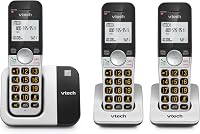
Choose this Panasonic if nuisance calls are your main reason for keeping a home phone. It combines three handsets with the strongest call-blocking set in this group.
The KX-TGD833M includes automated call block for robocalls, telemarketing call block for announced callers and a one-touch block button. A one-ring scam alert shows a confirmation screen when you return a suspicious call.
It also records two-way conversations, and the announcement that recording has started can deter suspicious callers.
The base runs on battery power and its answering system stores up to 17 minutes of messages. Its 10 hours of talk time and 120 hours of standby come from the rechargeable batteries.
It pairs with traditional landline networks, so it still needs a jack or a VoIP base to get dial tone.
Does a cordless phone base work in a power outage?
Not for long. The handset battery keeps calls going for a while, but the base needs wall power.
When the electricity fails, the whole system usually goes quiet.
That's why many homes keep one corded phone on a line that works without power. A corded phone draws its power from the phone line itself.
Check whether your provider supports that during an outage.
If you rely on a cordless phone for emergencies, keep a charged spare battery for the handset. Our guide to cordless phone batteries explains how to swap one and what to check before buying a replacement.
Spare batteries keep a handset usable longer, though they don't solve a dead base.
How do you set up a cordless phone without a landline?
Start with the base connection, then register the handsets. Plug the base into power and into whatever gives it dial tone, whether a wall jack, a VoIP device or a gateway port.
Next, put each handset on its cradle to charge. Most models register automatically, though some need a button press on the base.
Finally, make a test call from each handset and check the answering machine. If the handset shows no line, the base isn't getting dial tone.
That points to the jack, the cable or the VoIP device rather than the handset itself.
So, do cordless phones need a phone jack?
A traditional cordless phone needs a phone jack, but plenty of modern models don't. The base needs a dial tone from somewhere, and a wall outlet is only one of several sources.
Pick a standard cordless phone if you still have a landline and jacks in the house. Pick a VoIP base like the Ooma Telo if you have internet and want a home number without phone company wiring.
Pick a cell-pairing Panasonic if you've dropped the landline and want your mobile calls on a handset. The Panasonic KX-TGD833M is the one to choose when blocking robocalls matters most.
Before you buy, check what your home already has: a live wall jack, a modem with a phone port, or neither. That one answer decides which cordless phone setup fits your home.
Frequently asked questions
Can a cordless phone work without a landline?
Yes, if the base gets its calls another way. A VoIP adapter feeds dial tone through an ordinary phone jack, and a Link2Cell base pairs with a cell phone over Bluetooth.
Both give you a cordless handset without a traditional phone company line.
Does a cordless phone base work during a power outage?
Not for long. The handset runs on a rechargeable battery, but most bases need wall power, so calls stop when the electricity goes out unless you keep a backup supply.
A battery-powered base like the KX-TGD833M keeps working temporarily.
A corded phone is the usual fallback in a blackout.
Do I need a DSL filter with a cordless phone?
Only on a DSL internet line. A filter keeps the internet signal from interfering with voice calls.
On cable or fiber VoIP service you don't need one, since the internet and phone signals are kept apart already.